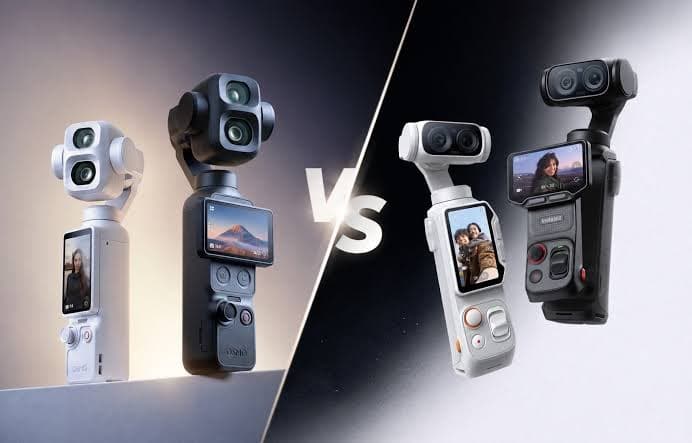
DJI has now put the Osmo Pocket 4P into the same conversation as Insta360's Luna Ultra, so the original version of this post had the wrong opponent. The Pocket 3 is still a strong little camera, but it is a 2023 single-lens product. Using it as the main benchmark against a new dual-lens Luna Ultra makes the comparison look cleaner than it really is.
The fair fight is Luna Ultra versus Pocket 4P. Both are compact stabilized cameras with a wide camera, a telephoto camera, creator-focused log profiles, and a promise that you can leave a larger kit at home.
Pocket 3 belongs in the value footnote now. Pocket 4P is the real test of whether Insta360 has outbuilt DJI.
The updated spec sheet
| Insta360 Luna Ultra | DJI Osmo Pocket 4P | |
|---|---|---|
| Main camera | 1-inch 8K sensor, 20mm equiv, f/1.8 | 1-inch 4K sensor, 20mm equiv, f/2.0 |
| Telephoto camera | 1/1.3-inch sensor, 60mm equiv, f/2.0 | 1/1.28-inch sensor, 60mm equiv, f/1.8 |
| Max video | 8K30, 4K120, 1080p240 | 4K240 on the main camera |
| Dynamic range | 14 stops claimed | 17 stops claimed |
| Log profile | 10-bit I-Log | D-Log 2 |
| Remote screen | Detachable 2-inch OLED included | Optional FrameTap remote in Vlog Kit |
| Built-in storage | 47GB | 103GB |
| Weight | 233g to 235g | 230g |
| Price signal | $769.99 in the US | CNY 3,799 in China, global pricing uncertain |
Round 1: the lens system
This is where the old Pocket 3 comparison broke down. Luna Ultra's second lens was not just a spec flex against the Pocket 3, it was an answer to the next version of DJI's product.
Against the Pocket 4P, the matchup is much closer. Both cameras give you a wide 20mm view and a 60mm telephoto view. Luna keeps the resolution advantage with an 8K main sensor. DJI counters with a slightly larger telephoto sensor, a brighter f/1.8 tele lens, and a 17-stop dynamic range claim on the main camera.
Winner: tie. Luna gets the cleaner 8K headline. DJI looks more balanced across both lenses.
Round 2: video modes
Luna Ultra still owns the resolution story. If your workflow benefits from 8K capture, reframing, or extra room for stabilization in post, that matters. It also supports Dolby Vision, 10-bit I-Log, 4K120, and 1080p240.
Pocket 4P flips the argument from resolution to motion. It tops out at 4K, but it can shoot 4K at up to 240fps on the main camera. For sports clips, product b-roll, dance, food shots, and travel details, I would rather have cleaner high-frame-rate 4K than 8K I rarely deliver.
Winner: depends on the job. Luna wins for crop-heavy 8K workflows. Pocket 4P wins if slow motion and dynamic range matter more.
Round 3: solo creator handling
The Luna Ultra's best idea is still its detachable screen. The display also works as a remote monitor and controller, which is exactly the kind of hardware feature that changes how a solo shoot feels. If the camera is across the room, on a tripod, or mounted in a weird place, having the controls in your hand is not a gimmick.
DJI can answer with the FrameTap remote, but that is tied to the Pocket 4P Vlog Kit rather than the base package. DJI's advantage is maturity. The Pocket line has years of tracking, accessory, microphone, and workflow polish behind it.
Winner: Luna Ultra for the included remote. DJI if you already live in the Osmo ecosystem.
Round 4: value and availability
This round is messy. The Luna Ultra is already a real US purchase at $769.99. That is expensive, but at least the buying decision is clear.
The Pocket 4P looks cheaper in China at CNY 3,799, roughly the mid-$500 range before taxes, import costs, and regional pricing. That would make DJI aggressive on value. The problem is availability, especially for US buyers, where recent DJI releases have been harder to buy through normal channels.
Pocket 3 still matters here, just not as the headline comparison. If someone wants the cheapest proven pocket gimbal and does not need the second lens, discounted Pocket 3 stock is a rational buy. That is a budget recommendation, not proof that Luna Ultra beats DJI's current best.
Winner: Luna Ultra on availability. Pocket 4P on expected value if you can buy it cleanly.
Verdict
The revised verdict is not Luna Ultra by a walkover. It is Luna Ultra by availability and remote-screen design, versus Pocket 4P by slow-motion muscle, storage, tracking maturity, and likely price.
If I were buying in the US today, I would lean Luna Ultra because I can actually get it and because the detachable control screen solves real solo-shooting problems. If DJI makes the Pocket 4P easy to buy at a meaningfully lower price, I would pause. The 4K240 mode, 103GB of built-in storage, and DJI's tracking stack make it the more dangerous rival than the Pocket 3 ever was.
That is the sentiment the original post missed. The category is no longer "Insta360 versus DJI's old champion." It is two new dual-lens pocket gimbals fighting over the same creator bag, and the winner depends less on brand loyalty than on whether you need 8K control flexibility or DJI's faster, more mature shooting pipeline.
For the wider accessory context around a camera purchase, see the June hardware shortlist, including its discussion of a compact recording microphone.