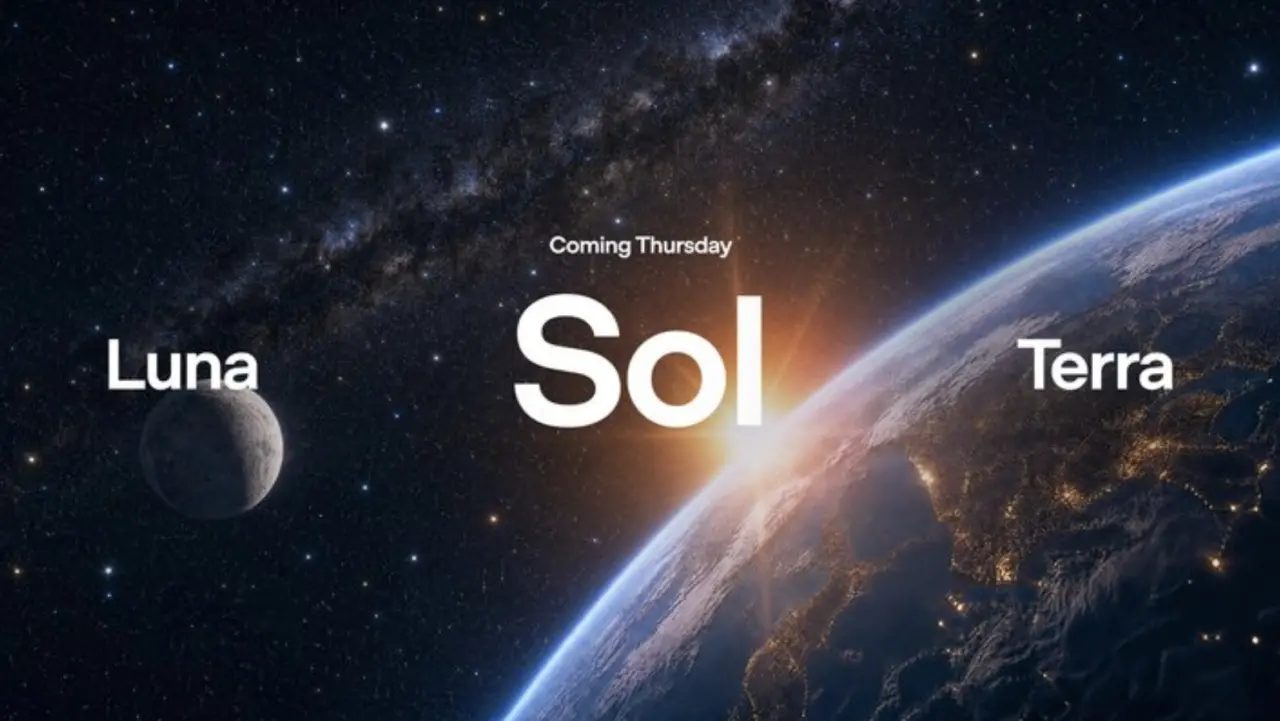
OpenAI launched GPT-5.6 on July 9, 2026, and the first thing worth understanding is that this is not one model with one personality.
It is a family: GPT-5.6 Sol, Terra, and Luna. Around that family sit reasoning settings such as max, a pro mode for quality-first API work, and ultra, which coordinates multiple agents for demanding jobs. If those names feel like too many knobs, that is because OpenAI is no longer packaging frontier AI as a single ladder from “cheap” to “smart.” It is packaging a small operating system for different kinds of work.
The useful question is not “Is GPT-5.6 better?” OpenAI's own benchmark tables make that claim in detail. The useful question is: which version should do which job, and when does more compute stop being worth it?
The family in one table
| Option | What it is | Best fit | API price per 1M tokens |
|---|---|---|---|
| Sol | The flagship model | Hard coding, research, design, cyber, and knowledge work | $5 input / $30 output |
| Terra | The balanced model | Everyday professional and agent work where cost still matters | $2.50 input / $15 output |
| Luna | The fast, efficient model | High-volume workflows, routing, extraction, and routine tasks | $1 input / $6 output |
| max | A reasoning-effort setting | Problems that benefit from more exploration, checking, and revision | More latency and tokens |
| ultra | A multi-agent product mode | Large tasks that split cleanly into parallel workstreams | Highest compute use |
The default gpt-5.6 API alias points to Sol. OpenAI's migration guide recommends starting with the same reasoning effort you already use on GPT-5.5 or GPT-5.4, then testing one level lower. That advice matters more than the headline benchmarks. If the new family can preserve quality at a lower effort, the win appears in the invoice and the latency chart, not just an evaluation table.
My default would be simple:
- Start new production experiments on Terra.
- Promote difficult cases to Sol when an evaluation proves the gain.
- Use Luna for repeatable, high-volume work with strong validation.
- Reserve max for the small slice of tasks where extra deliberation changes the result.
- Use ultra only when the work genuinely decomposes.
That is less exciting than setting everything to the largest option. It is also how a useful system survives contact with a budget.
The biggest change is not the benchmark score
GPT-5.6's most important developer feature may be Programmatic Tool Calling.
Traditional tool-using agents bounce between model turns and tool responses. The model asks for data, the application returns it, the model reads the full output, and the cycle repeats. GPT-5.6 can instead write and run lightweight JavaScript in an isolated hosted runtime. That program can call eligible tools in parallel, loop, branch, process intermediate results, and return only the useful result to the model.
For a workflow that checks 200 records across several systems, that can mean fewer round trips and less context filled with raw tool output. The model becomes an orchestrator that can also write a small disposable controller.
There is an important boundary. OpenAI's guide recommends direct tool calls for writes, approvals, and tasks where every result needs fresh judgment. Programmatic Tool Calling is best for bounded stages with predictable data flow: fetch, filter, join, rank, validate, and summarize. It is not permission to hide a dangerous sequence of side effects inside generated code.
That distinction is excellent. “Can the model do this?” is the wrong safety question. “Can a human still see and approve the consequential boundary?” is much better.
Max and ultra are not the same thing
The launch adds two ideas that sound similar but solve different problems.
Max gives one model more time to reason, explore alternatives, check work, and revise. It is the next step above xhigh reasoning effort. Use it when the task is difficult because the solution itself is hard.
Ultra attacks a different bottleneck: elapsed time. In Codex and ChatGPT Work, ultra coordinates four agents in parallel by default. OpenAI says some evaluations also tested wider configurations. In the API, developers can build similar patterns with the multi-agent beta.
Use ultra when the task can be divided without creating four copies of the same confusion. Researching independent markets, reviewing separate modules, or testing several hypotheses can parallelize well. A tightly coupled architecture decision may not. More agents amplify the structure of the task—good or bad.
This is why “multi-agent” should not become a decorative checkbox. Before turning it on, write down the workstreams, the evidence each one must return, and the rule for synthesizing conflicts. If you cannot name those boundaries, one strong agent may be the better choice.
The benchmark story is efficiency
OpenAI positions Sol as its strongest coding model and reports state-of-the-art results on several coding, terminal, browsing, computer-use, cybersecurity, and science evaluations. The launch also emphasizes fewer output tokens, lower estimated cost, and shorter completion time against earlier or competing models.
Those claims are worth testing, not repeating as universal truth.
Benchmarks tell us that a capability exists under a particular harness. They do not tell us whether your repository, review culture, customer data, latency target, or error budget will see the same improvement. OpenAI's own model guidance says to compare task success, completeness, evidence, tokens, latency, and cost on representative work.
I would add two more columns to that evaluation:
- Human correction time. A cheaper answer that needs 20 minutes of cleanup is not cheaper.
- Failure visibility. A model that fails clearly can be safer than one that produces polished, difficult-to-detect errors.
GPT-5.6's design improvements make this especially relevant. Better visual polish is useful, but polish can raise the cost of noticing that the underlying product decision is wrong.
Safety is part of the product choice
OpenAI's system card rates Sol, Terra, and Luna as High capability in both Biological and Chemical risk and Cybersecurity, while keeping them below High in AI self-improvement. The launch says none of the models crossed its Critical threshold in biology or cybersecurity.
That is notable because the smaller, faster models receive the same High designation in tracked categories for the first time. “Smaller” no longer means “safe enough to ignore.”
OpenAI is responding with model safeguards, real-time classifiers, monitoring, account controls, and trusted-access programs for qualified defensive work. Developers still own the application boundary: permissions, audit logs, stable user identifiers, scoped tools, approval gates, and incident response.
The more capable the agent becomes at computer use and end-to-end execution, the less acceptable vague authorization becomes.
A practical migration plan
I would migrate a real workload in five passes:
- Freeze a representative evaluation set. Include normal tasks, edge cases, and failures that hurt.
- Test Terra first. Compare it with the current model at the same reasoning effort and one level lower.
- Route selectively. Send only the cases that miss the quality bar to Sol, max, or pro mode.
- Add programmatic tools to one bounded read-heavy stage. Measure token savings and verify that evidence survives the reduction.
- Try multi-agent work last. Parallelize only after the single-agent workflow, permissions, and success criteria are stable.
Also watch prompt caching. GPT-5.6 introduces explicit cache breakpoints and a 30-minute minimum cache life. Cache reads keep a 90% discount, but writes cost 1.25 times the uncached input rate. A badly chosen caching strategy can turn an efficiency feature into a quiet surcharge.
My take
GPT-5.6 looks less like another chatbot release and more like OpenAI formalizing how serious AI work is already being done: model routing, adjustable reasoning, tool orchestration, persisted context, computer use, and multiple agents.
The naming will take a minute. The product logic is sound.
Luna makes intelligence cheap enough to distribute. Terra should cover more everyday work than teams expect. Sol is the escalation path. Max spends more time on one hard problem. Ultra spends more parallel effort on a decomposable one.
The winning GPT-5.6 deployment will not be the one that selects the strongest setting everywhere. It will be the one that knows when not to.
For applying the model-family comparison to actual workloads, continue with the budgeted GPT-5.6 model-router guide.